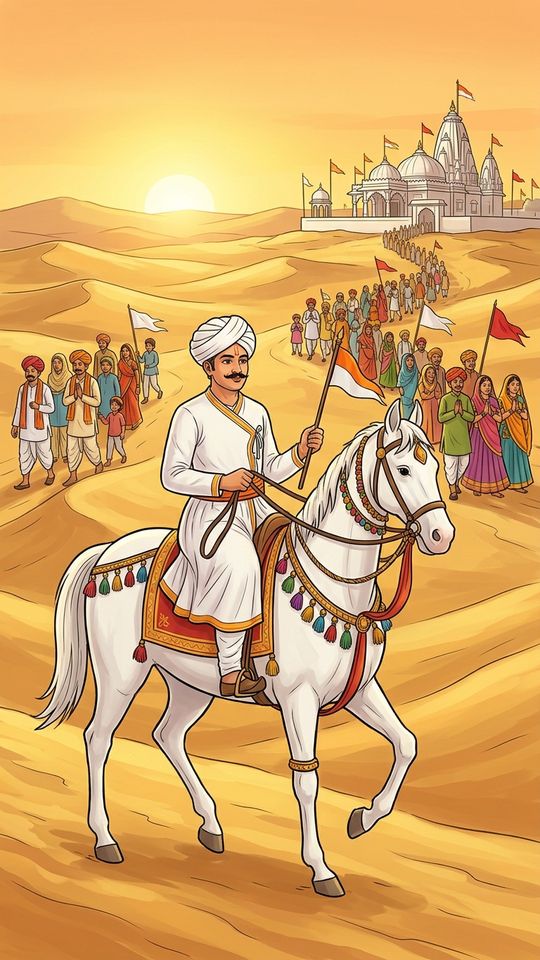
Who was Baba Ramdev?
Baba Ramdev was the son of Ajmal Ji Tanwar, ruler of the Pokhran region. His mother is named Mainade. He is placed around the fourteenth–fifteenth century (sources give different years).
A boon from Dwarka
According to the folk tale, King Ajmal Ji had no children for a long time. In sorrow he went to Dwarka and prayed to Krishna, who is said to have promised to come to his home as his son. That is why devotees regard Baba Ramdev as an incarnation of Krishna.
Baba of everyone
Baba Ramdev did not accept distinctions of high and low. The story of his adopted sister Dali Bai symbolises this. His devotees include people of every community and faith — which is why he is also called a "Pir".
Dali Bai's bangle
Near Baba's samadhi at Runicha is a large stone ring linked to Dali Bai. It is believed that passing under it removes illness and suffering.
The Ramdevra fair
The great Ramdevra fair begins on Bhadrapad Shukla Dwitiya, known as "Baba ri Beej". Lakhs of pilgrims walk from Rajasthan, Gujarat and Madhya Pradesh carrying white and red flags. It is also called the "Kumbh of Marwar".
On the Ramdevra pilgrimage, a darshan of Baba's guru Balinath Ji is also considered important.
Frequently asked questions
Where is the Baba Ramdev temple?
Baba Ramdev's samadhi and main temple are in Ramdevra (Runicha), Jaisalmer district, Rajasthan — about 12 km north of Pokhran.
When is the Ramdevra fair?
The great Ramdevra fair begins on Bhadrapad Shukla Dwitiya (Baba ri Beej).
Why is Baba Ramdev called Ramsa Pir?
Both Hindus and Muslims worship Baba Ramdev. Muslim devotees call him "Ramsa Pir" or "Ramshah Pir".
This article is based on folk tales, temple traditions and public sources. Folk tales exist in many versions; the best-known ones are given here.