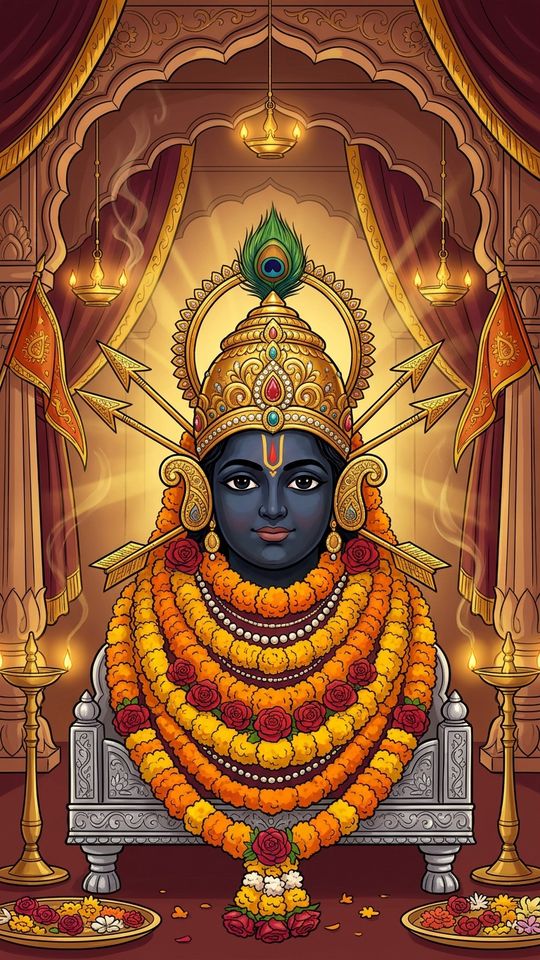
Who was Barbarik?
Barbarik was the grandson of the mighty Bhima and the son of Ghatotkacha. His mother is said to be Morvi (Kamakantaka). He was an extraordinary archer from childhood. According to legend, through penance to the Goddess he received three arrows powerful enough to decide an entire war on his own — which is why he is also called the "bearer of three arrows".
A promise to his mother
As the Mahabharata war approached, Barbarik promised his mother that he would always fight on the side that was losing. That promise became his identity — "Haare Ka Sahara", the support of the defeated.
Why did Krishna ask for his head?
Krishna realised this vow would never let the war end. Whichever side began to lose, Barbarik would join it, until only he remained. So Krishna came to him disguised as a Brahmin and asked for his head as a gift.
Barbarik gave it without hesitation. His only wish was to watch the entire war. Krishna placed his head on a high hill from where he saw the whole Mahabharata. Tradition holds that this gift was made on Phalgun Shukla Dwadashi.
Krishna blessed Barbarik that in the Kali Yuga he would be worshipped by Krishna's own name, "Shyam", and that anyone who called his name with a true heart would be heard.
How was the head found at Khatu?
According to local belief, in the Kali Yuga Barbarik's head was found buried in Khatu village. A cow is said to have released milk on its own at one particular spot. When the ground was dug, the head appeared. The place is now called "Shyam Kund", where devotees bathe.
History of the Khatu Shyam temple
The first temple is said to have been built by Roop Singh Chauhan and his wife Narmada Kanwar after the head was found. The present temple was rebuilt later. Khatu is about 43 km from Sikar city and about 80 km from Jaipur. The nearest railway station is Ringas.
The Phalgun Lakhi Mela
Every year a huge fair is held here in the month of Phalgun, attended by lakhs of devotees. Many walk from Ringas to Khatu carrying a "nishan" (flag). Phalgun Shukla Ekadashi and Dwadashi are considered the biggest days of the fair.
Things to know
- He is called "Sheesh ke Daani" (giver of his head), "Teen Baan Dhaari" and "Haare Ka Sahara".
- He is worshipped only in the form of his head.
- In one belief Khatu Shyam is considered a form of Krishna himself.
Frequently asked questions
Who is Khatu Shyam Ji?
Khatu Shyam Ji is Barbarik, a warrior of the Mahabharata, grandson of Bhima and son of Ghatotkacha. By Krishna's blessing he is worshipped as "Shyam" in the Kali Yuga.
Why is Khatu Shyam called Haare Ka Sahara?
Barbarik promised his mother he would always fight for the losing side. That vow earned him the name "Haare Ka Sahara" — support of the defeated.
Where is the Khatu Shyam temple?
In Khatu village, Sikar district, Rajasthan — about 43 km from Sikar and 80 km from Jaipur.
When is the Khatu Shyam fair held?
The main Lakhi Mela is held in Phalgun. Phalgun Shukla Ekadashi and Dwadashi are its biggest days.
This article is based on folk tales, temple traditions and public sources. Folk tales exist in many versions; the best-known ones are given here.