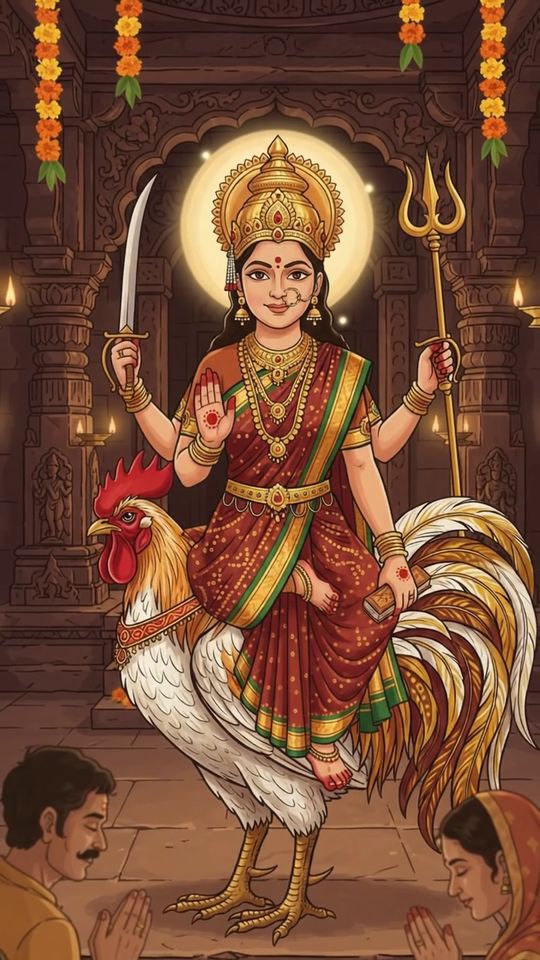
Why a rooster?
Many believe the Solanki dynasty were great devotees of Maa Bahuchar and that their royal flag bore a rooster. But another story is very popular in folk memory, linked to a single crow of a rooster.
The story of one crow
According to the folk tale, after conquering Patan an invading army reached Bahucharaji. Seeing the temple's splendour, the order was given to loot it. That night the soldiers caught the Goddess's roosters roaming in the courtyard, cooked and ate them. Only one rooster survived, hiding behind a stone.
The next morning that rooster was silent. The Goddess asked why it had not crowed. The rooster said — "Maa, all who crowed with me are gone." The Goddess said — "Do your duty."
The rooster crowed… and in reply hundreds of crows rang out from inside the soldiers. Terrified, the whole army fled the temple.
Since then the rooster has been regarded as Maa Bahuchar's vahana.
The form of Maa Bahuchar
Maa Bahuchar is depicted with four arms, holding a sword, a trident and a scripture, with one hand raised in blessing. She sits on a rooster.
Bahucharaji Dham
Bahucharaji is in Mehsana district, about 35 km from Mehsana city and about 25 km from Modhera. The present main temple was built in 1839 by Manajirao Gaekwad. Every year a big multi-day fair is held on Chaitra Purnima (Chaitri Punam), when the Goddess's palanquin travels at night to nearby Shankhalpur. A special festival is also held during Navratri. Many families in Gujarat worship Maa Bahuchar as their kuldevi.
Frequently asked questions
What is Bahuchar Mata's vahana?
Bahuchar Mata's vahana is a rooster.
Where is the Bahucharaji temple?
The Bahucharaji temple is in Mehsana district of north Gujarat.
Why is Bahuchar Mata's vahana a rooster?
One belief links it to the rooster on the Solanki dynasty's flag. A folk tale says a rooster's crow drove away an army that came to loot the temple.
This article is based on folk tales, temple traditions and public sources. Folk tales exist in many versions; the best-known ones are given here.