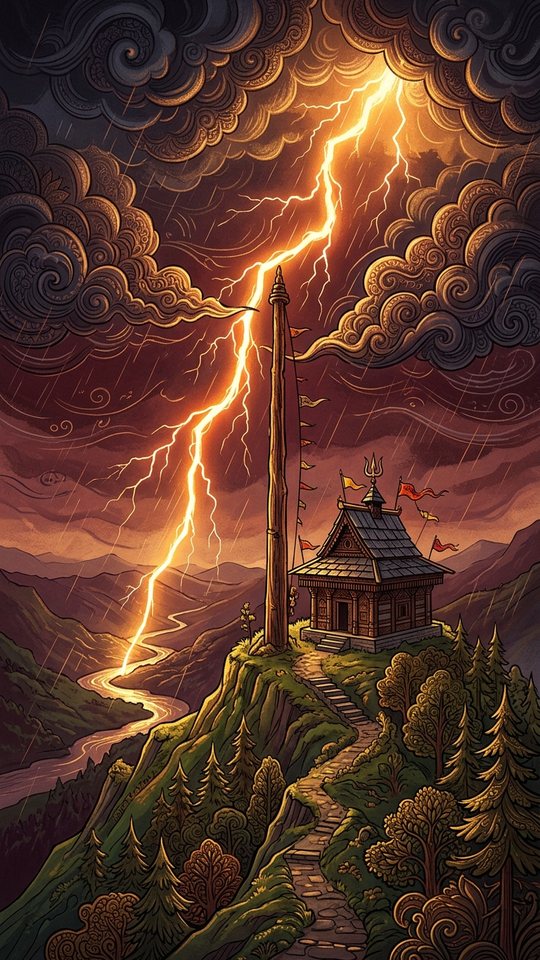
The legend of Kulant
The folk tale says a demon named Kulant came into the valley as a giant serpent. He wanted to block the Beas river and drown the whole valley. Lord Shiva destroyed him with his trident. The demon’s huge body became a mountain, and the name "Kullu" is said to come from Kulant.
An order to Indra
The story goes on that Shiva asked Indra to strike this mountain with lightning from time to time. People believe Shiva takes the lightning on himself so that the people and animals of the valley stay safe.
Here lightning is not destruction; it is Shiva’s blessing.
A Shivling joined with butter
When lightning strikes, the Shivling shatters. The priests gather the pieces and join them with fresh village butter and sattu. After some time the Shivling looks whole again. Some say this happens every 12 years, others every Sawan.
The tall flagstaff
Beside the temple stands a wooden pole about 60 feet tall that glints like a silver needle in the sun. It is believed to draw the lightning.
Getting there
The temple is about 22–25 km from Kullu. You drive to Chansari/Mansari and trek about 3 km. The top gives a view of the Kullu and Parvati valleys.
Frequently asked questions
Why does lightning strike Bijli Mahadev?
Folk belief says Shiva takes the lightning on himself to protect the valley; the tall pole also attracts it.
How is the broken Shivling repaired?
Priests join the pieces with butter and sattu.
How high is Bijli Mahadev?
About 2,460 metres.
This article is based on folk tales, temple traditions and public sources. Folk tales exist in many versions; the best-known ones are given here.