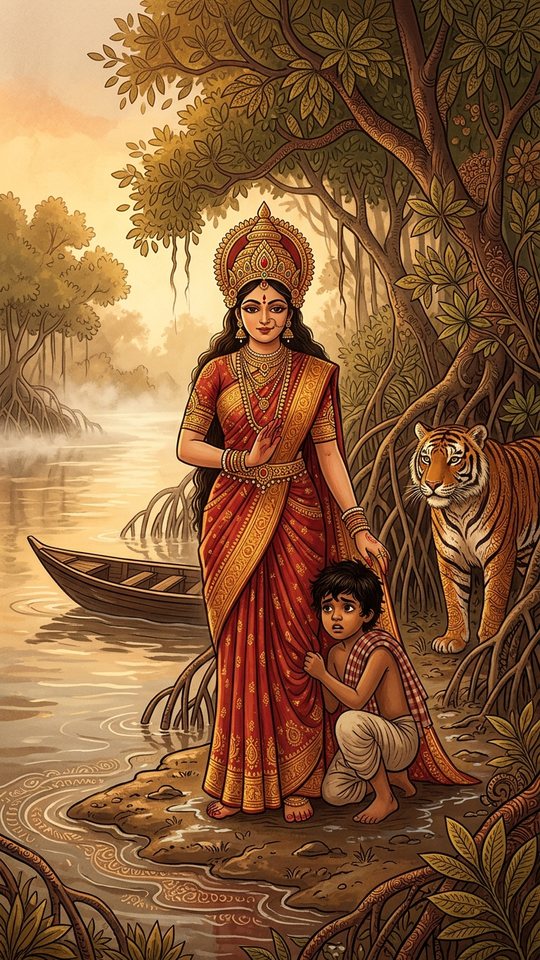
Dakshin Rai, the demon who became a tiger
In the story, Dakshin Rai (Dokkhin Rai) rules the deep forest and attacks humans in the form of a tiger. Bonbibi fought him and established her rule over the inhabited part of the forest, leaving the deep jungle to Dakshin Rai.
The story of Dukhe
Dukhe was a poor boy who went to gather honey with his greedy relative Dhona. Before he left, his mother told him, "In trouble, remember Bonbibi." Dakshin Rai struck a deal with Dhona: leave Dukhe behind and you will get plenty of honey and wax. Out of greed, Dhona abandoned Dukhe on an island and sailed home.
When Dakshin Rai, as a tiger, leapt at Dukhe, the boy cried out for Bonbibi.
Bonbibi arrives
Bonbibi came with her brother Shah Jangali, who defeated Dakshin Rai. Bonbibi sent Dukhe home to his mother; the story says her pet crocodile carried him to his village. Dakshin Rai asked for forgiveness and promised not to harm humans.
The religion of the forest
Even today, forest workers see themselves as "Dukhe" and pray to Bonbibi for protection. At her shrines, Shah Jangali, Dukhe and Dakshin Rai are worshipped with her. In some places she looks like Lakshmi, in others like a Sufi figure. The "Bonbibi jatra" performs this story as folk theatre.
Frequently asked questions
Who is Bonbibi?
The forest goddess of the Sundarbans, worshipped by both Hindus and Muslims for protection from tigers.
Who is Dakshin Rai?
In the story, the king of the deep forest who takes the form of a tiger.
Who was Dukhe?
A poor boy whom Bonbibi saved from Dakshin Rai in tiger form.
This article is based on folk tales, temple traditions and public sources. Folk tales exist in many versions; the best-known ones are given here.