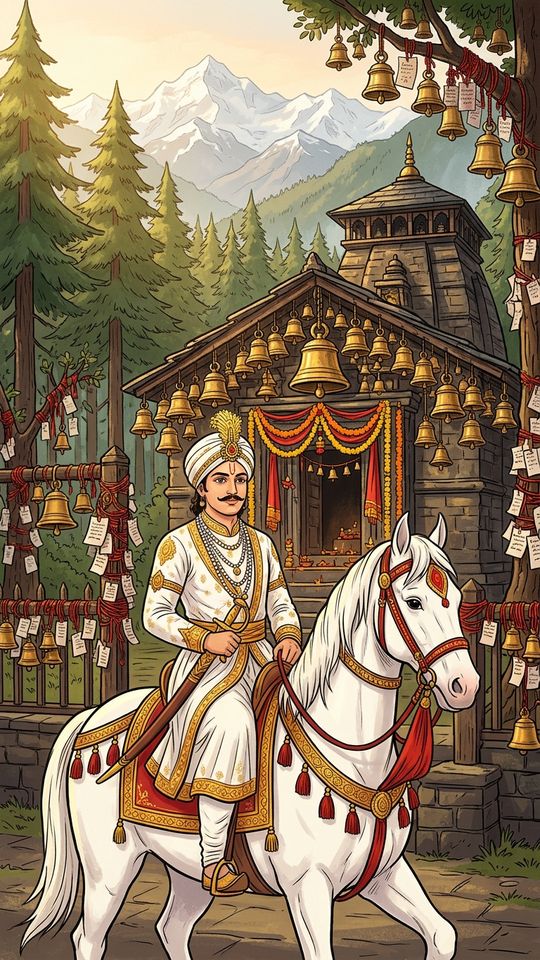
The story of King Jhal Rai
According to the folk tale, King Jhal Rai of the Katyuri dynasty had seven queens but no child. He later married Kalinka, and she became pregnant. The other queens grew jealous.
A stone and a floating box
When Kalinka gave birth to a son, the queens secretly replaced the baby with a stone, shut the boy in a box and set it afloat on a river. A fisherman found the box and raised the boy as his own.
The wooden horse
When the boy grew up he asked for a horse, and his father gave him a wooden one. One day he took the wooden horse to drink at the same pond where the seven queens had come. The queens laughed — "Can a wooden horse ever drink water?"
The boy replied — "If a queen can give birth to a stone, a wooden horse can drink water."
The king heard this, the truth came out, and the boy got his rightful place. This boy came to be worshipped as Golu Devta, the giver of justice.
The tradition of letters
At Golu Devta's temples devotees write their problems on paper or stamp paper and hang them up. Many even send petitions by post. When a wish is fulfilled, devotees offer a bell — which is why Chitai is called the "temple of bells".
Main temples
- Chitai Golu temple: about 8–10 km from Almora. It is said to have been built in the 12th century by a general of the Chand dynasty.
- Ghorakhal temple: near Nainital.
- Champawat: a key place linked to Golu Devta's story.
Frequently asked questions
Why is Golu Devta called the god of justice?
Golu Devta is believed to deliver true justice. Devotees write their problems in petitions, hang them in his temple and pray for justice.
Where is the Chitai Golu Devta temple?
It is about 8–10 km from Almora, Uttarakhand, on the Almora–Pithoragarh road.
Why do devotees offer bells to Golu Devta?
When a wish is fulfilled, devotees offer a bell as thanks.
This article is based on folk tales, temple traditions and public sources. Folk tales exist in many versions; the best-known ones are given here.