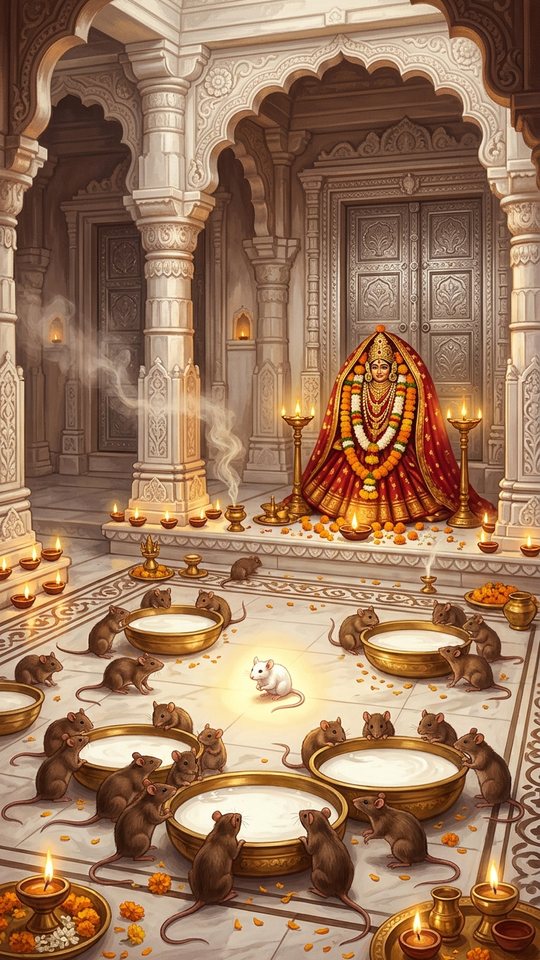
Who was Karni Mata?
Karni Mata is revered by the Charan community as an incarnation of Shakti. Tradition places her in the 14th–15th century. She married but chose an ascetic life, and arranged for her husband Depaji to marry her younger sister.
Laxman and Yama
The story goes that Laxman, a boy of Karni Mata’s family, drowned in a pond. She asked Yama, the god of death, to return him. Yama refused at first, then gave in to her devotion. Since then it is believed that members of her clan are reborn as rats in the temple, and later return as humans.
That is why the rats here are called "kabba", the little ones of the family.
The white kabba
Among thousands of black rats are a few white ones. They are believed to be forms of Karni Mata and her sons. Seeing a white kabba, or having one run over your foot, is considered very lucky.
Temple rules
- Walk barefoot, and shuffle your feet so you don’t hurt a kabba.
- If a kabba dies by accident, tradition asks you to offer a rat made of silver or gold.
- Eating prasad nibbled by the kabba is considered an honour.
- The temple administration also enforces a ban on cutting trees in Deshnoke.
The marble gateway
The white marble facade was added in the 20th century by Maharaja Ganga Singh of Bikaner. Kabba are carved on the silver doors too.
Frequently asked questions
Why are there rats in Karni Mata temple?
Folk belief says Karni Mata’s descendants are reborn here as rats (kabba).
Why is a white rat lucky?
White kabba are believed to be forms of Karni Mata and her sons.
When is the Karni Mata fair?
Twice a year, during Chaitra and Ashwin Navratri.
This article is based on folk tales, temple traditions and public sources. Folk tales exist in many versions; the best-known ones are given here.