Mani and Malla
The story goes that two demon brothers, Mani and Malla, won a boon from Brahma through penance and began terrorising the earth. Shiva then took the form of Khandoba (Martanda Bhairava). The battle lasted six days. Malla never repented, so Khandoba killed him and was called "Malhari", enemy of Malla. Mani asked for forgiveness and promised to serve the people, so he was spared.
That is why Khandoba is shown with a sword in one hand and a bowl of turmeric (bhandara-patra) in the other.
Two wives, one hill
Khandoba has two chief wives: Mhalsa, from a merchant family, and Banai, a shepherd’s daughter from the Dhangar community. Folk songs tell of their quarrels. To settle them, Khandoba is said to have given the upper part of the hill to Mhalsa and the lower part to Banai. Banai’s shrine is on the path down.
Bhandara: the turmeric festival
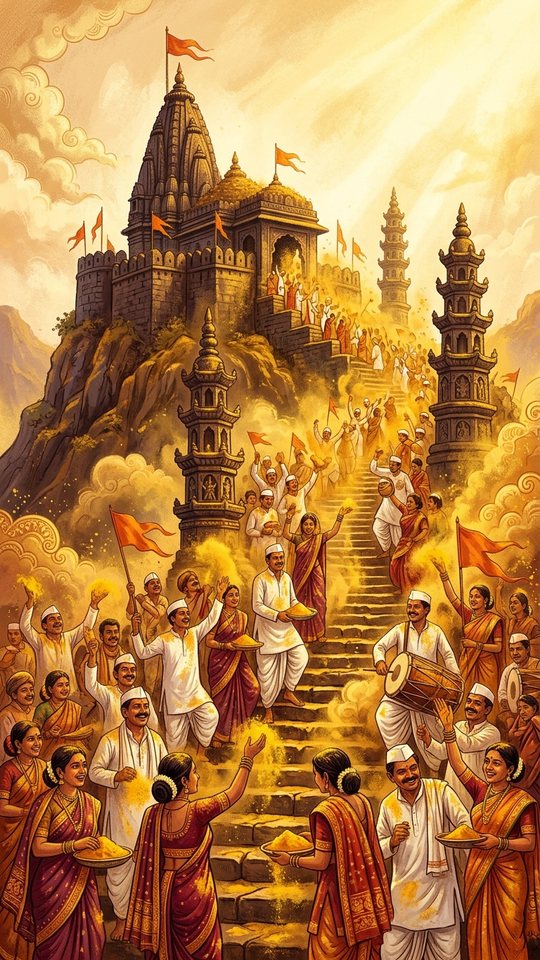
On Somvati Amavasya, when the new moon falls on a Monday, devotees bring tonnes of turmeric to Jejuri and throw it on the god, on each other and into the sky. With cries of "Yelkot yelkot jai Malhar", the whole hill turns gold.
Champa Shashti
Margashirsha Shukla Shashthi is celebrated as Champa Shashti, linked to Khandoba’s victory over Mani-Malla. In 2026 it falls on 15 December.
Frequently asked questions
Whose incarnation is Khandoba?
Khandoba is worshipped as an incarnation of Shiva (Martanda Bhairava).
Why is it called Sonyachi Jejuri?
During the Bhandara festival tonnes of turmeric make the whole hill look golden.
Who are Khandoba’s wives?
Mhalsa and Banai.
This article is based on folk tales, temple traditions and public sources. Folk tales exist in many versions; the best-known ones are given here.