The birth of Janbai
According to the folk tale, a devotee named Mamadiya Ji had no children for a long time. After worshipping Shiva, he was blessed with seven daughters and one son. One of the seven sisters was Janbai.
A journey to the underworld for her brother
One day her brother Merkhiya was bitten by a snake. To save him, amrit (nectar) was needed — found only in the underworld. Janbai set out fearlessly for the underworld.
How did she get the name "Khodiyar"?
While returning with the nectar, Janbai hurt her foot and began to limp. In Gujarati, limping is called "khod". From then on Janbai was called "Khodiyar".
Khodiyar Maa's name reminds us that every pain borne for one's family becomes worthy of worship.
The crocodile mount
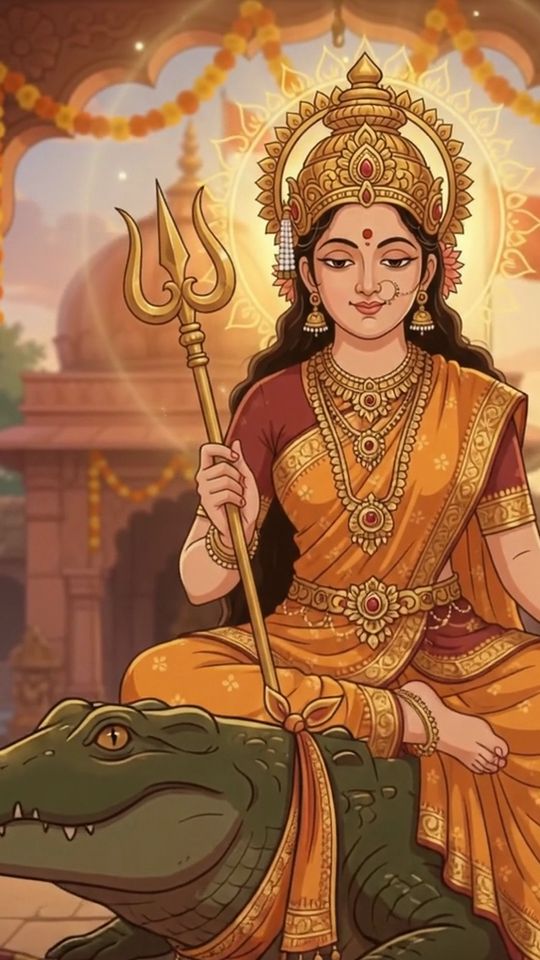
Khodiyar Maa's vahana is a crocodile. Stories say a crocodile helped her on the way back from the underworld or across water. That is why idols and pictures show her seated on a crocodile.
Main temples
- Matel (Morbi district): a very old and famous shrine of Khodiyar Maa.
- Rajpara (Bhavnagar): the temple on the bank of the lake here is very well known.
- Galdhara: a riverside shrine near Dhari.
Frequently asked questions
What was Khodiyar Maa's real name?
According to the folk tale, Khodiyar Maa's real name was Janbai.
What is Khodiyar Maa's vahana?
Khodiyar Maa's vahana (mount) is a crocodile.
Where are Khodiyar Maa's main temples?
Matel (Morbi), Rajpara (Bhavnagar) and Galdhara (near Dhari) are her main shrines.
This article is based on folk tales, temple traditions and public sources. Folk tales exist in many versions; the best-known ones are given here.