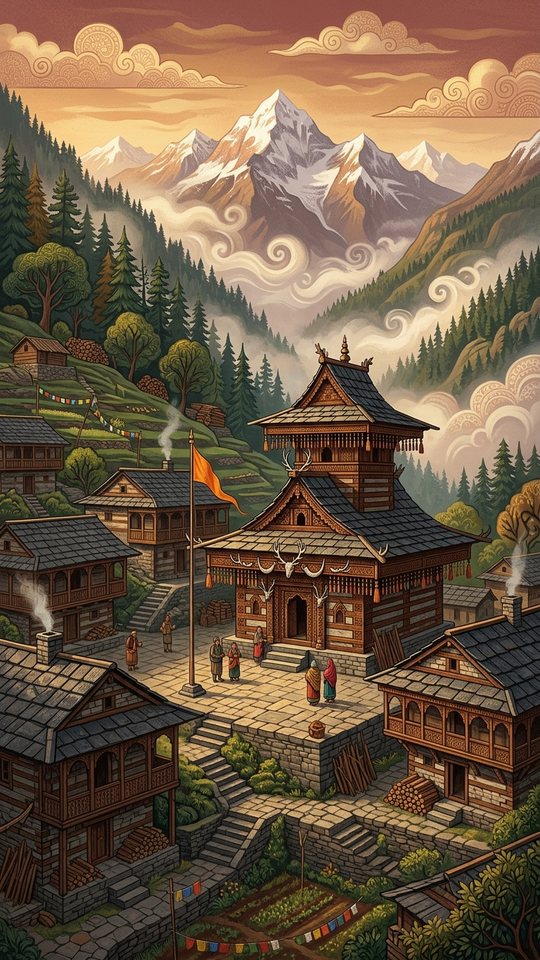
Who is Jamlu?
Malana’s people see Jamlu Devta as a folk form of Rishi Jamadagni, who chose this place for meditation. Jamlu is worshipped as a "khanda" and speaks through his "gur", the person the god possesses.
The god’s parliament
The village is run by a council whose decisions are made in Jamlu Devta’s name. It has elected members, and disputes are settled by the god’s tradition. That is why Malana is called one of the "oldest democracies".
The villagers have consulted the god even on whether to accept a road.
The "do not touch" rule
Outsiders may not touch village property, temples or people. Touching by mistake brings a traditional fine of a few thousand rupees. "Do not touch" signs hang across the village.
The Akbar legend
An old tale says the Mughal emperor Akbar acknowledged Jamlu’s power and sent images to Malana. A festival linked to Akbar is still observed in the village.
The Alexander belief
A folk belief says Malana’s people descend from soldiers of Alexander who settled here. There is no firm proof, but their language, Kanashi, is very different from the languages around it.
Frequently asked questions
Who is Jamlu Devta?
The chief deity of Malana, seen as a form of Rishi Jamadagni.
Why can’t you touch things in Malana?
Village tradition holds that an outsider’s touch breaks purity; there is a fine for it.
Why is Malana called the oldest democracy?
Because its council has governed the village in the god’s name for centuries.
This article is based on folk tales, temple traditions and public sources. Folk tales exist in many versions; the best-known ones are given here.