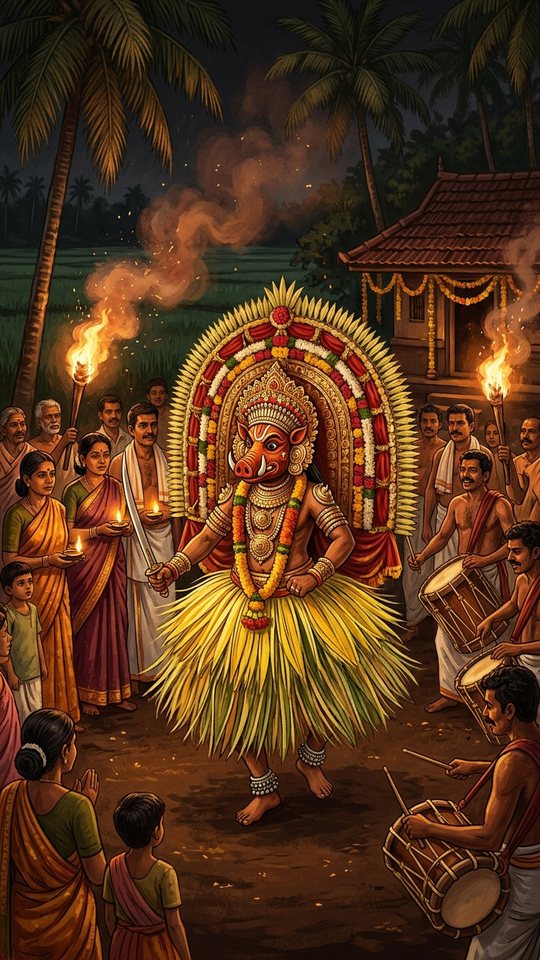
The boar cub of Kailash
The Tulu folk tale says a wild boar died in Shiva’s garden on Mount Kailash, leaving a small cub alone. Goddess Parvati took pity on it and raised it.
Shiva’s anger, Parvati’s plea
As it grew, the boar became wild and began destroying the plants and trees of Shiva’s garden. Angry, Shiva wanted to punish it. Parvati pleaded for mercy. Shiva spared it, but said it could no longer stay on Kailash: it must go to earth and protect the people.
That is why Panjurli is also called "Shiva Sambhoota", born of Shiva.
Guardian of the fields
Panjurli is worshipped especially to protect crops from wild boars and to guard the village. In Tulu, "Panjurli" is said to mean a boar’s young one. Some also link him to Varaha, the boar avatar of Vishnu.
Bhoota Kola
Panjurli is worshipped in "Bhoota Kola" (also Daiva Kola or Nema). In this all-night ritual a performer in bright make-up, a costume of tender coconut leaves and a mask takes the spirit’s form. To the beat of drums the daiva enters him; he settles villagers’ disputes and gives blessings. Guliga, Jumadi and many other daivas are worshipped in the same tradition.
Frequently asked questions
Who is Panjurli?
A boar-faced guardian spirit (daiva) of Tulunadu, coastal Karnataka.
When is Bhoota Kola held?
Usually between December and May.
Is Panjurli the god from the film Kantara?
Yes. Panjurli and Guliga shown in Kantara are real daivas worshipped in Tulunadu.
This article is based on folk tales, temple traditions and public sources. Folk tales exist in many versions; the best-known ones are given here.